


Home
Mission
The mission of the Center for Neurodegenerative Disease Research (CNDR) is to promote and conduct multidisciplinary clinical and basic research to increase the understanding of the causes and mechanisms leading to brain dysfunction and degeneration in neurodegenerative diseases such as Alzheimer’s disease (AD), Parkinson’s disease (PD), Lewy body dementia (LBD), Frontotemporal degeneration (FTD), Amyotrophic lateral sclerosis (ALS), Primary lateral sclerosis (PLS), Motor neuron disease (MND), and related disorders that occur increasingly with advancing age. Implicit in the mission of the CNDR are two overarching goals: 1.) Find better ways to cure and treat these disorders, 2. Provide training to the next generation of scientists.
“My vision for CNDR is to create a world with effective interventions to prevent and cure aging-related neurodegenerative diseases.” – Eddie Lee, MD, PhD, Director of CNDR
John Q. Trojanowski, MD, PhD | 1946 - 2022
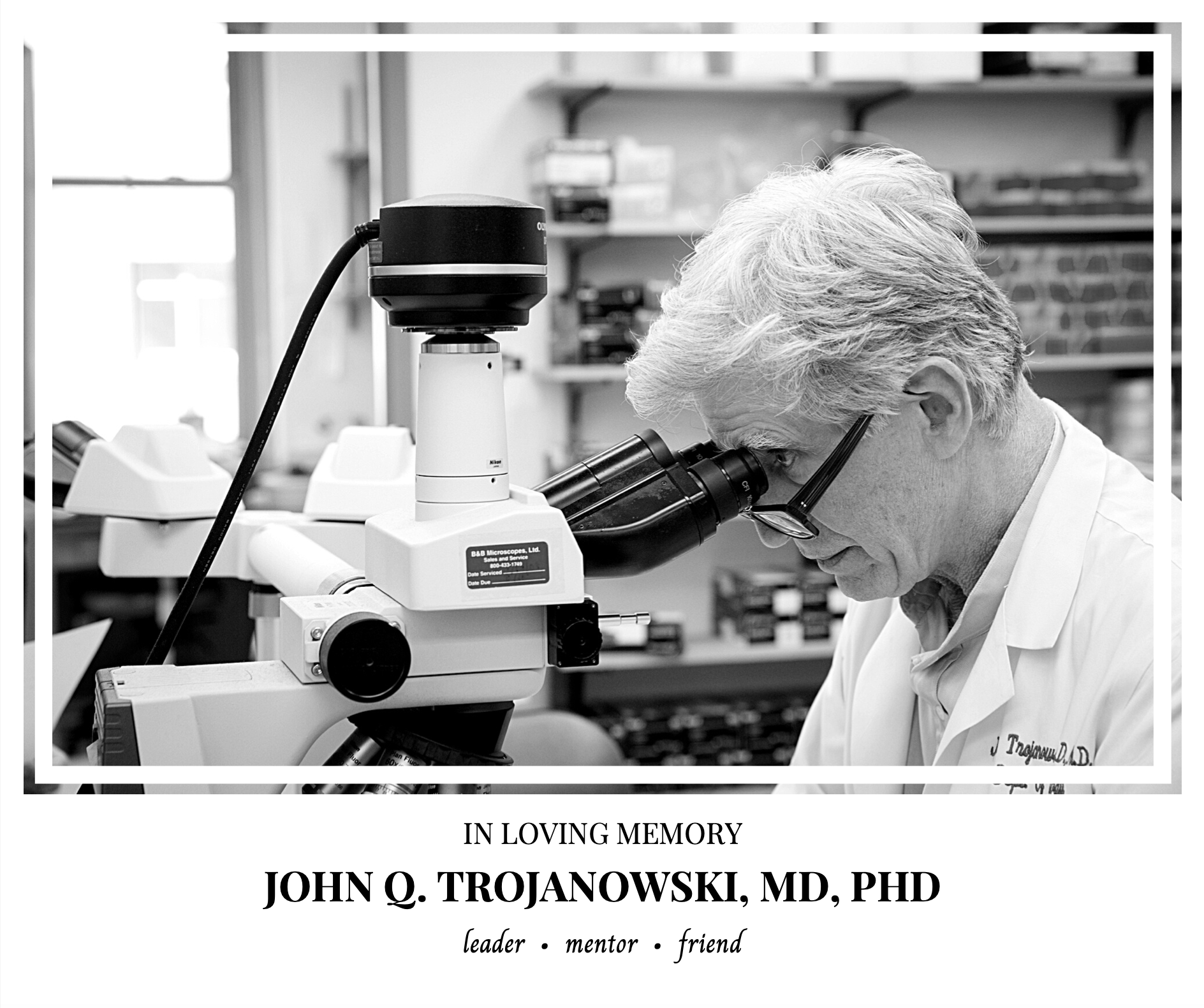
In loving memory of John Q. Trojanowski, MD, PhD
Latest Research
-
Study of the utility and impact of a plasma p-tau181 Alzheimer's biomarker (SUITABLE)
Monday, June 8, 2026
INTRODUCTION: Blood-based Alzheimer's disease (AD) biomarkers are increasingly used in clinical care, but there are few real-world studies of their clinical utility. We evaluated the impact of plasma phosphorylated tau at threonine 181 (p-tau181) on the diagnosis and management of patients with cognitive impairment in a memory clinic.
-
Tau topography subtypes account for clinical heterogeneity and longitudinal trajectories in early-onset Alzheimer's disease
Monday, June 8, 2026
The growing availability of large-scale biomarker datasets has allowed data-driven methods to characterize Alzheimer's disease biological heterogeneity. However, most prior studies have focused on cohorts of late-onset amnestic cases, leaving early-onset Alzheimer's disease underexplored. We aimed to characterize tau-PET-based subtypes through a robust data-driven approach in the Longitudinal Early-Onset Alzheimer's Disease Study. Baseline [^(18)F]Flortaucipir PET scans from 365...
-
Creating a Dementia Caregiver Assessment Tool for Home Health: User-Centered Development, Refinement, and Content Validity Testing
Tuesday, June 2, 2026
In the United States, home health care (HH) provides skilled nursing, therapy, and aide services delivered in patients' homes. One-third of HH patients have diagnosed dementia and these individuals rely heavily on support from family and unpaid caregivers during HH care. Yet, caregiving context is not systematically assessed in HH, presenting a barrier to high-quality care for patients with dementia. Partnering with a major HH agency, we developed a dementia caregiver assessment tool designed to...